A Wrong Digit on a Customs Form: $1 to Catch Now, $100 to Fix Later
A shipping-document error is cheap to catch at the desk and expensive at the border. The 1-10-100 rule applied to customs paperwork, and where an AI operations layer catches the mismatch before it escalates.
On this page
TL;DR
- A customs or shipping document is only correct if every field is correct, and every field is keyed and checked by a person.
- The 1-10-100 rule from quality management says a defect costs roughly 1 to catch at the source, 10 to fix downstream, and 100 once it reaches failure. A shipping document follows that curve exactly.
- The cheapest place to catch a document error is the moment it is created. That is also the moment a manual desk is least able to catch it, because nothing is checking the field against reality in real time.
- An AI operations layer on top of the ERP and the other systems you already run can check each field as the document arrives and flag the mismatch at the "1" stage, before it becomes a "100".
- If your team keys and eyeballs trade documents by hand, book a working session and we will map where the errors enter and where they get caught today.
One wrong digit
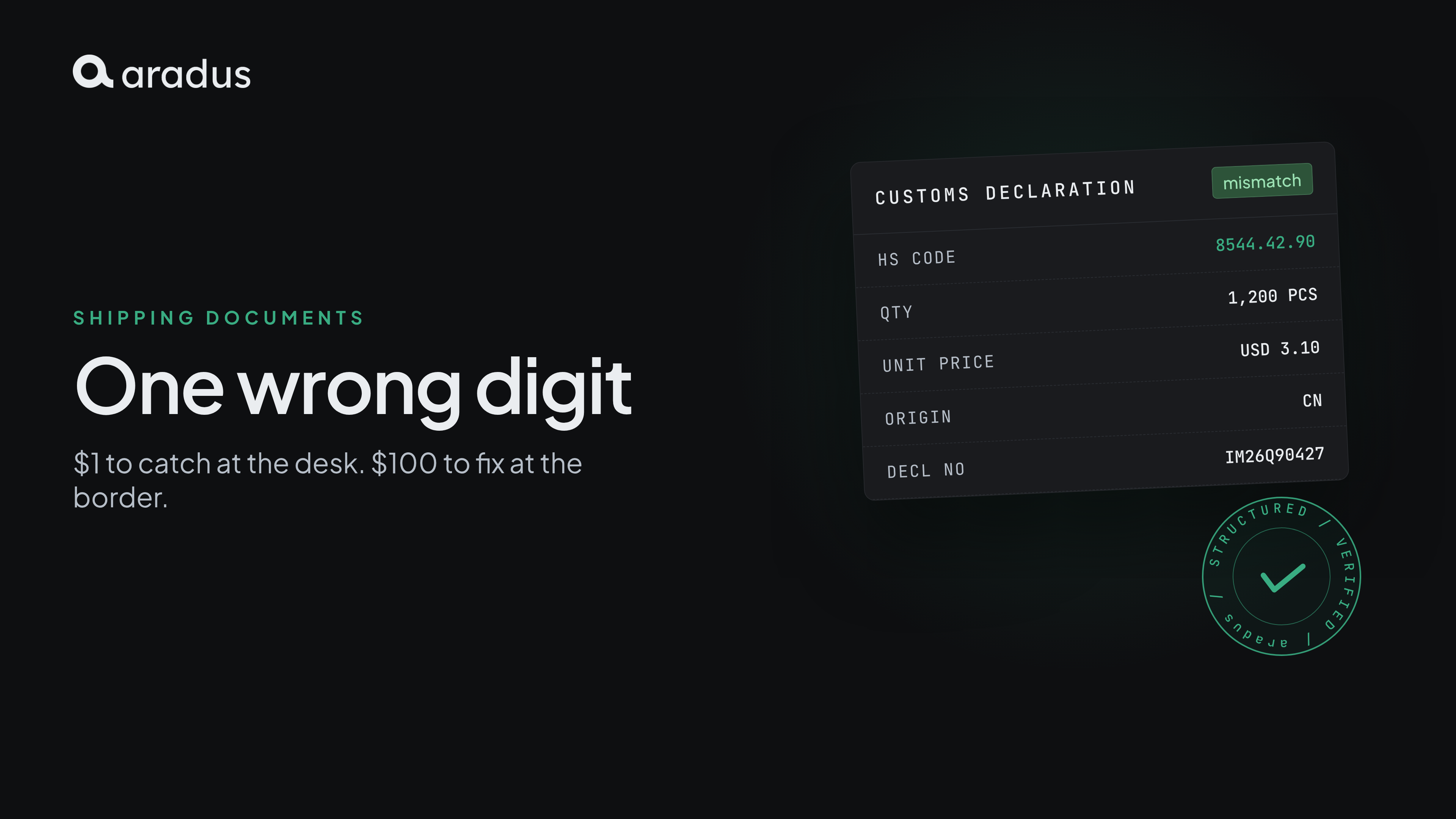
An HS code is off by two digits. A quantity on the commercial invoice does not match the packing list. A unit price does not match the agreed order. None of these is dramatic when it happens. Someone is keying a document at a desk, they are moving fast, and a field is wrong. At that moment it is a 30-second fix, if anyone notices.
The problem is that almost nobody notices at that moment, because the person keying the field is the only check on the field. The document then travels. It goes onto a declaration, into a broker's hands, to a border. And the longer that one wrong digit survives, the more it costs to fix.
The 1-10-100 rule, applied to a shipping document
The 1-10-100 rule is an old idea from quality management. George Labovitz and Yu Sang Chang put it in their 1992 book Making Quality Work: catching a defect at the source costs about 1, correcting it once it is inside your process costs about 10, and letting it reach failure costs about 100. The numbers are a ratio, not a price list. The point is the shape: cost rises by roughly ten times at each stage a defect survives.
Put a shipping document on that curve.
At the desk (the "1"). The HS code, quantity, or price is wrong as it is typed. If a check catches it here, the fix is trivial. Retype the field, move on.
In transit (the "10"). The error is now on a submitted declaration or a document already sent to the forwarder or broker. Fixing it means amended paperwork, a round of back-and-forth, and hours lost before the goods can move. Nothing physical has gone wrong yet, but the work to correct it has multiplied.
Worth being concrete about what "a round of back-and-forth" actually is, because it is the hidden cost in the middle of this curve: somebody has to get on the phone to whoever issued the document, explain exactly which field is wrong and what it should say, and chase the reissue. That call is four minutes of work and it frequently does not happen for days. We wrote about who makes it in the calls nobody makes.
At the border and after (the "100"). The mismatch triggers a customs hold. Worth noting what this looks like from the inside: nobody sees a document error, they see a container that has stopped moving and no obvious reason why. The paperwork cause and the visible symptom are days apart. The container sits and accrues demurrage. There may be a penalty for the misdeclaration, and in the worst case a re-export. A problem that started as one wrong digit is now a five-figure event with your name on it, and it is being solved under time pressure by people who did not create it.
This is why "we double-check the important ones" is not a strategy. The expensive errors are not the ones that look important at the desk. They are ordinary fields that happened to be wrong and happened to survive.
Why the error survives to the expensive stage
Most teams assume the ERP is the safety net. It is not, and it was never meant to be. This is the same category gap we wrote about in why an ERP does not eliminate the manual work around it: a system of record keeps what it is given. It records the document after a person has keyed it, and it only knows what is already inside it. It does not read the customs form as it is being prepared and check the HS code against the order, the quantity against the packing list, the price against the PO. That checking is left to a human, at the exact moment, at the desk, when the human is least equipped to do it well.
So the error enters at the cheapest stage to fix and gets caught, if at all, at the most expensive one. The curve runs the wrong way for you by default.
How aradus connects, on top of the systems you already run
aradus is an AI operations layer that sits on top of your ERP and the other systems you already run, not a replacement for them. For document errors, the job is to move the catch point back to the "1": read the document as it arrives, check each field against the order and shipment context aradus already holds, and flag the mismatch before the document is submitted anywhere.
Two parts of this are already running in the product today, and it is worth being precise about which:
- Watching the rules. Regulations change, and a document that was correct last quarter can be wrong this quarter. aradus runs a compliance monitoring service today that watches the relevant sources and flags changes against the products a business actually ships, so a shipment does not carry an out-of-date classification. This runs as a weekly service for an enterprise group, described in how importers manage changing tariff regulations without a compliance team.
- Catching the mismatch on the money side. On incoming supplier bills, aradus already matches the bill against the purchase order and the goods actually received, flags the discrepancy, and versions the document so the trail is auditable. That is the same "catch it at the 10, not the 100" move applied to procurement, described in how to match invoices without an AP team.
Catching every field error on every trade document as it is created, end to end, is where the product is heading rather than a finished, customer-proven claim we will overstate here. What is proven is the pattern: a field checked against context at the moment of entry is a "1", and the same field caught at the border is a "100".
How this works, and where a person stays in the loop
The mechanic is simple to describe:
- aradus reads the document as it arrives, across email and PDF, and extracts the fields.
- It checks each field against the context it already has: the order, the shipment, the current rules for the destination.
- It flags a mismatch immediately, at the desk stage, with the specific field and the value it expected.
- Judgment calls stop for a person. A genuine exception, a field aradus is not confident about, or anything non-obvious is raised for a human to decide, not auto-corrected.
The goal is not a system that files your customs paperwork for you. It is a second set of eyes on every field, in real time, so the wrong digit is caught while it still costs 1.
What good looks like next to the manual desk
| Manual desk | Broker or border catches it | aradus on top of your ERP | |
|---|---|---|---|
| Where the error is caught | Sometimes, if someone re-checks | At the "10" or the "100" stage | At the "1" stage, as the document arrives |
| What the check compares against | The keyer's own attention | The declaration in isolation | The order, shipment, and current rules already in your systems |
| Cost when it works | Low, but unreliable | Amended paperwork, holds, demurrage, penalties | The field is corrected before it moves |
| Who decides the hard cases | Whoever is at the desk | Broker, under time pressure | A person, flagged early with the specific mismatch |
What aradus does not replace
aradus is not a customs broker, not a filing or declaration system, and not your ERP's document store. It does not take over your trade compliance function or file on your behalf. It flags the mismatch early, on top of the systems you already run, so the people who own the paperwork are working from a corrected document instead of chasing an error that already reached the border.
What this requires first
- The order and shipment context in a system aradus can read. The check is only as good as the reality it compares the document against.
- Documents reaching one place aradus can see as they arrive, rather than scattered across personal inboxes.
- Agreement on where the human line sits: which flags auto-resolve and which always stop for a person.
Get those in place and the catch point moves back to the desk, where a document error still costs 1.
Close
The 1-10-100 curve is not a law of nature. It only runs against you because, by default, nothing checks the field at the moment it is created. Move the check to that moment and the same error that would have cost 100 at the border costs 1 at the desk.
If your team keys and eyeballs trade documents by hand, book a working session. We will map where document errors enter your process and where they get caught today, and show you where the catch point can move.